
Wetlands play a crucial role in water security and biodiversity. Yet they are under strain, in Flanders and far beyond. With its Christmas campaign on social media, LCL wants to make that reality tangible. Every share of the campaign post helps protect wetlands through Join For Water. Part of the proceeds will also support the management of the Assels nature reserve near Ghent, led by Natuurpunt. For this article, we spoke with Kim Vercruysse, Programme Coordinator at Join For Water, and Ward Stulens, volunteer and reserve warden at Natuurpunt.
Anyone who has walked through the Assels near Ghent will recognise it straight away: a landscape that lives on the boundary between land and water. This wet grassland floods, then drains again, and never looks quite the same twice. When black-tailed godwits reappeared, it briefly felt like a piece of good news. “They’re indicator species,” Ward says. “If they come back, you hope the ecosystem is breathing again.” Today, they have disappeared once more, mainly because there are too few insects, their food source. It is a stark reminder of how fragile wetlands can be.
That fragility also shows up thousands of kilometres away, for example in Fort Portal, Uganda. Where wetland protection in Flanders often means restoration, in Uganda the priority is to keep what still exists. Join For Water is active there. Based in Ghent, the organisation protects water and water-dependent ecosystems in countries where pressure on nature is rising fast.
Join For Water began in the 1970s as Protos, a group of engineers building wells and sanitation infrastructure in places with limited access to safe drinking water. Today, the organisation works from Ghent, with offices in Africa and South America, on a much broader mission.
“We start from the right to water, today and in the future,” Kim explains. In Belgium, Join For Water focuses on awareness-raising. They inform the public about water footprints and the role of water in our daily lives, and they also work with young people through school programmes. Abroad, they put their mission into practice through projects that improve access to water and protect water-bearing nature.
That two-track approach matters. “You can build a well,” Kim says, “but if the source dries up because the area is not protected, then access to water is not guaranteed. That’s why we work just as hard on nature conservation, awareness, and knowledge-sharing as we do on infrastructure.” They do not do it alone. “Our role is to bring the right people together: local organisations, citizens, and authorities. We facilitate, advise, and build knowledge, so solutions continue to work in the long term.”
“We facilitate, advise, and build knowledge, so solutions continue to work in the long term.”
In Flanders, the focus is often on recovery. In the Assels, it took years before the ecosystem began to show resilience again. Volunteers, researchers, and site managers, working with Natuurpunt, tracked the changes closely: insect populations returning, rare birds reappearing, and water staying in the soil for longer.
In Uganda, the tension looks different. Wetlands are still relatively intact, but they face intense pressure from urban growth and the need for farmland. “It’s far more efficient to protect what is still there than to restore it later,” Kim says. “That’s why we focus so strongly on protection in Uganda.”
One practical measure is to mark out wetlands using clearly visible boundary pillars. They show, on the ground, what is legally protected. “It sounds simple,” Kim adds, “but it makes everything clearer for farmers, local residents, and authorities.” At the same time, Join For Water works with farmers on realistic alternatives, so protection does not automatically mean loss of income.
The contrast between “restoring here” and “protecting there” shows why cooperation between Flemish and international actors matters. Both regions are grappling with similar pressures: water stress, biodiversity loss, intensive land use, and climate change. “Climate change is becoming very acute,” Ward says. “It accelerates everything, and it’s a serious problem for wetlands. There’s almost no middle ground anymore. It’s either soaking wet or bone dry.”
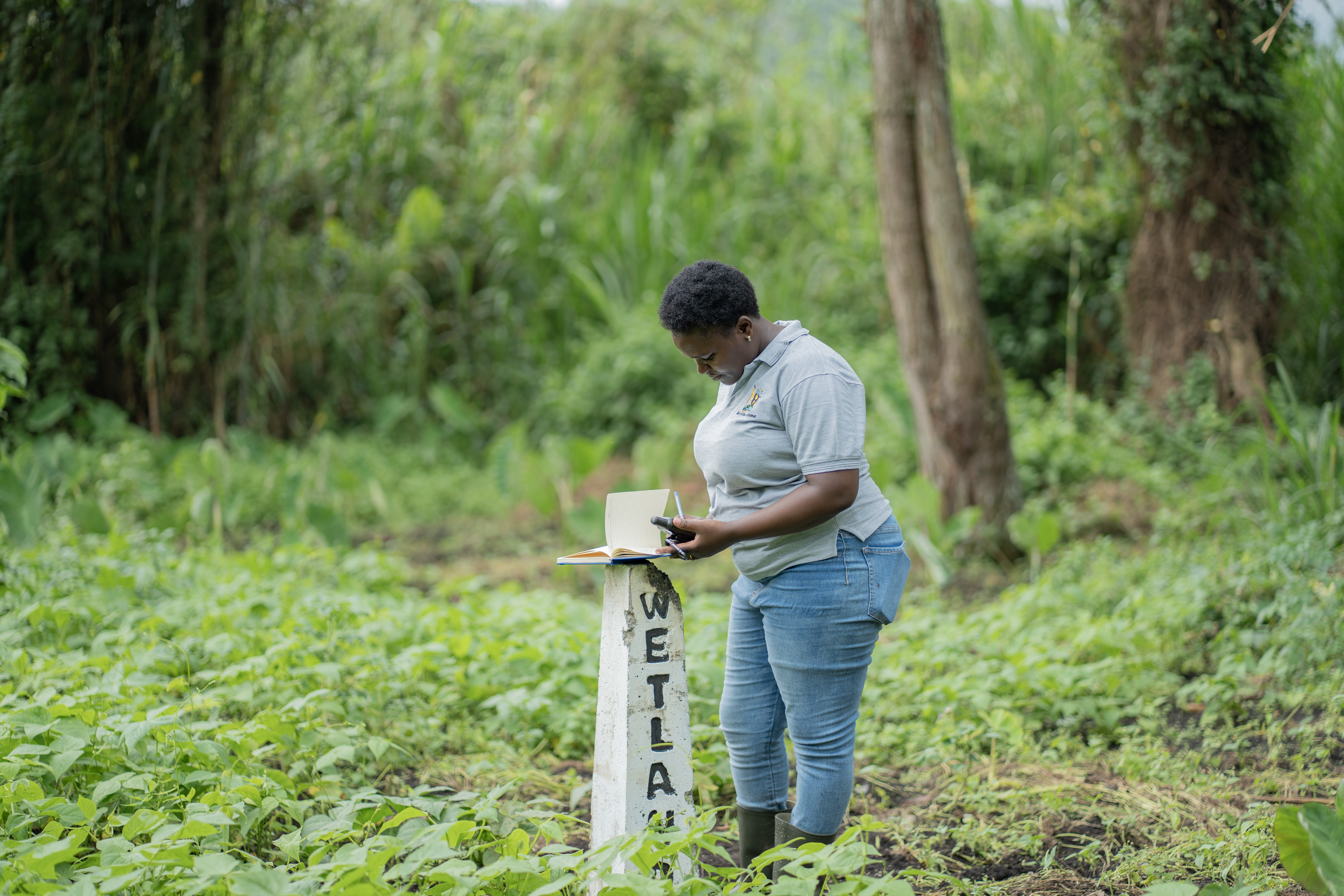
Join For Water and Natuurpunt jointly run the ‘Move For Water’ initiative, which supports wetland protection in the Assels near Ghent and in Fort Portal, Uganda. The partnership makes sense. Both organisations work in similar ways: long-term management, volunteer engagement, knowledge-sharing, and building a deep understanding of ecosystems over time.
“Natuurpunt works closely with volunteers, citizens, and different stakeholders to protect nature areas in a sustainable way,” Kim says. “That’s also what we aim for in our projects, just in other countries. In the end, ecosystems worldwide influence the global water cycle. When you make that link, our story becomes more complete.”
“In the end, ecosystems worldwide influence the global water cycle. When you make that link, our story becomes more complete.”
Around the world, international cooperation and nature projects are under pressure. Governments invest less, while the need is growing. That makes partnerships with companies increasingly important for Join For Water, not as one-off sponsorships, but as long-term relationships in which both sides strengthen each other.
A first collaboration, with LCL supporting ‘Move For Water’, fits that approach. LCL is deeply rooted in Belgium, works with international partners, and places sustainability at the heart of its strategy. Water also forms part of that commitment.
LCL’s data centers use a closed-loop water circuit for cooling. This means the cooling system does not consume mains water, and, across its five sites, LCL’s total water use is comparable to that of only two households. Even so, water appears as a material topic in the company’s Double Materiality Assessment (DMA). That transparency shows that efficient water stewardship is achievable in the sector. The principle is simple: water matters to LCL because it matters to the planet and to society. From that perspective, the partnership with Join For Water is a natural fit.
During the Christmas period, LCL is directly linking its social media campaign to the mission of Join For Water. For every share of the campaign post, Join For Water will protect one square metre of wetland. Ten per cent of the proceeds will go to Natuurpunt for the management of the Assels, strengthening local nature protection as well.
This is not an abstract number. It is a surface area you can picture. Ten shares, for example, protect a piece of wetland roughly the size of a small meeting room. Anyone who wants to help can do so in the simplest possible way: share the campaign on social media.

Subscribe to our newsletter and receive monthly news about LCL, our innovations, our services, our events