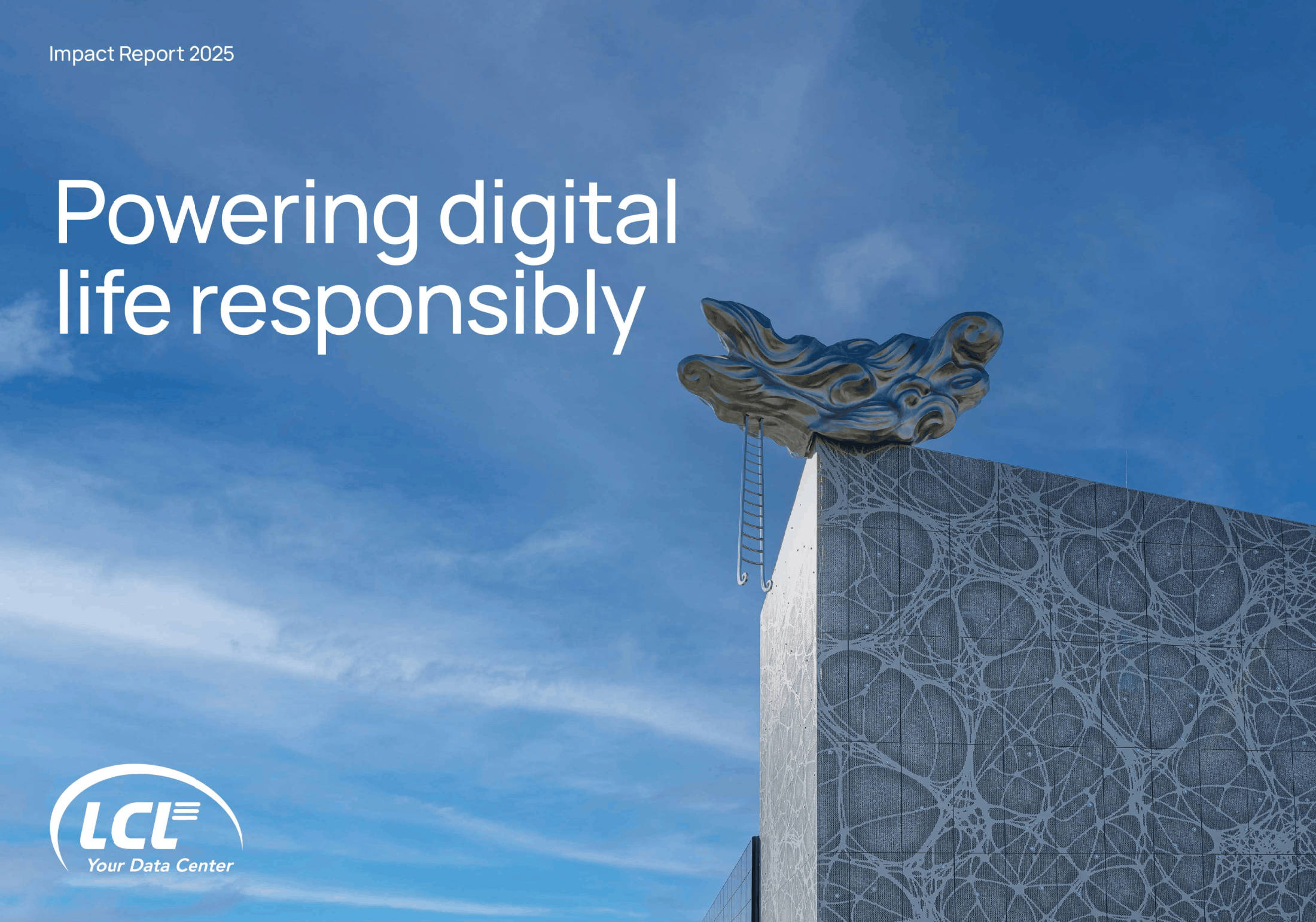
Brussels, 4 June 2026 - At a time when data centers are coming under increasing pressure with regards to their energy and water consumption, Belgian data center company LCL has published its Impact Report 2025. The report highlights how the company combines strong growth with a proactive approach to sustainability and digital autonomy. Under the theme Powering digital life responsibly, LCL positions itself not only as an essential link in the digital economy, but also as a company that takes responsibility for its societal and environmental impact.
The growing demand for digital capacity, driven in part by AI and cloud applications, makes data centers one of the most energy-intensive infrastructures within the digital economy. LCL has consciously taken matters into its own hands to actively build its own generation capacity.
Today, LCL generates more than a third of its energy consumption via three company-owned wind turbines and solar panels. The remaining electricity is completely sourced from renewable sources.
LCL continues to further invest in additional in-house generation capacity, including with a new solar park on the roofs of four agricultural sites in East and West Flanders. This 3 million euros investment produces an annual output of 3.0 gigawatt-hours. Solar panels have also been installed on the facades the LCL Brussels-North and LCL Brussels-West sites.
In addition to energy, growing attention is converging toward water consumption within the sector, making sustainable water management an increasing imperative. Water availability is threatening to become a determining factor for new data center projects in various European regions. LCL is anticipating this limitation by focusing on rainwater recovery and reuse capacity.
Four of LCL’s five data centers operate in closed-loop cooling systems, with the same water continually circulating within a circuit rather than being continuously replaced. At the LCL Wallonia One site, a new system capable of reusing approximately 550 m³ of rainwater annually was installed in 2025. The combined results of these initiatives translate into a Water Usage Effectiveness (WUE) of 0.07 l/kWh, well below sector benchmarks.
This positions LCL as one of the leading players in Europe for efficient water management in data centers.
The geopolitical context is becoming increasingly decisive, and European companies and governments are increasing scrutiny regarding:
As a 100% Belgian, independent partner, LCL explicitly addresses these issues. Local infrastructure is presented not only as an operational choice, but also as a strategic risk management measure as a response to growing demand for digital autonomy.
LCL’s sustainability strategy is not treated separately from the company’s financial results. In 2025, LCL recorded a 42% increase in turnover to 42.6 million euros, and saw its EBITDA grow by 68% to 2.03 million euros. Around a third of this revenue is reinvested in infrastructure and sustainability.
LCL opts for maximum transparency regarding its impact. The company voluntarily applies European CSRD regulations, eventhough it is not yet legally mandatory. This also includes communicating openly about the challenges: ESG performance that fluctuates due to investment cycles, and real trade-offs between energy, water and technology choices.
With this report, LCL aims to set a benchmark for how data center companies in Belgium can address their social and environmental responsibilities in a transparent and accountable manner.
‘Although data centers often operate behind the scenes, they are now an essential part of almost every digital aspect of daily life. This omnipresent role carries a responsibility, particularly in a society rightly asking critical questions about sustainability,’ says Laurens van Reijen, CEO of LCL Data Centers. ‘With this report, we are opting for transparency: showcasing our impact, our actions and our objectives. Not because we have to, but because we believe this comes with being a forward-looking sector.’
The full Impact Report 2025, containing all figures and objectives, is available here.
Subscribe to our newsletter and receive monthly news about LCL, our innovations, our services, our events