
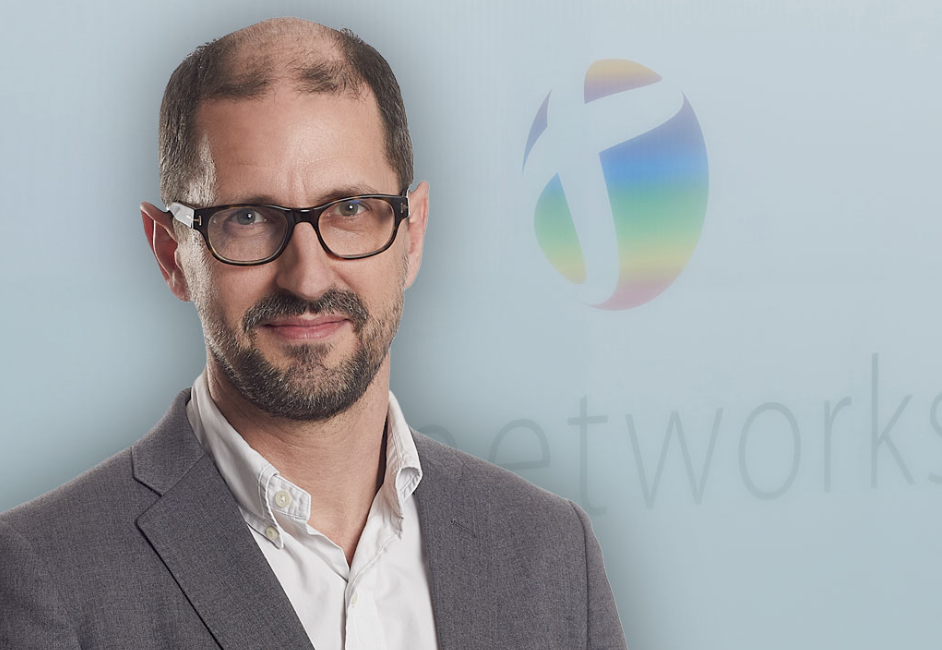
“We connect the places where bandwidth matters most,” says Toby Williams, Chief Product Officer at euNetworks. With more than 45,000 kilometres of fibre across 17 countries and over 574 connected data centers, euNetworks is a driving force behind Europe’s digital economy. Its expansion in Belgium is closely tied to LCL’s role as a hub for international connectivity, highlighting how interdependent carriers and data centers are when it comes to building a resilient, sustainable digital future.
Toby Williams: “EuNetworks is a pure bandwidth infrastructure company. Our focus is clear: we build and operate fibre networks that connect the data centers, cable landing stations and media hubs where Europe’s digital traffic flows. From hyperscalers and cloud providers to financial institutions and broadcasters, our customers rely on us for low latency, high-capacity and highly resilient connectivity. In that sense, we provide the backbone for Europe’s digital transformation.”
“We differentiate in four areas: service, scale, innovation and values. Customers know us for being reliable and responsive, with integrity being a part of our DNA. The scale of our connected data centers is unique, with deep metro coverage in 18 cities combined with long-haul routes across Europe. We’ve also pioneered innovations like ultra-low latency fibre for trading, spectrum services and now post-quantum encryption. At the same time, we deliberately keep our product set simple, so customers get speed, flexibility and clarity.”
“Belgium is strategic for us. With the acquisition of a nationwide duct and fibre footprint, we can offer end-to-end coverage, especially in Wallonia. In Brussels we’re building our 18th metro network, interconnecting key data centers, including LCL sites. That strengthens Belgium’s role as a connectivity hub in Europe. We’re also deploying metro optical technology for higher scalability, and helping customers with data sovereignty requirements and encryption solutions that anticipate the post-quantum era.”
“The biggest challenge we see is power and space scarcity in the major hubs: Frankfurt, London, Amsterdam, Paris and Dublin. New data center sites are often developed further away from existing clusters and our networks have to extend and diversify to support them. You know, this is a capital-intensive business. Every kilometre of fibre requires significant investment and planning. On top of that, regulatory frameworks and planning permissions vary across countries and can slow deployment. Add to this the long investment cycles, and it’s clear why building resilient infrastructure takes time and persistence.”
“Another driver is artificial intelligence. Training large models may be happening mainly in the US, but inference workloads in Europe are growing fast. That creates demand for bandwidth, low latency and resilience. We also see new entrants offering GPU-as-a-service, which again depends on robust fibre infrastructure. And you also have to consider rising concerns about security, resilience and sustainability. The sum of all this makes it crystal clear: the role of the network is more critical than ever.”
"Customers expect green infrastructure. And so do we. That’s why we value LCL’s leadership”
“Our success depends on strong data center partners like LCL. Their sites offer the reliability and customer intimacy we look for, and they share our commitment to sustainability. That combination is rare. When LCL grows, we grow with them. And when we innovate, their customers benefit. That’s the strength of the partnership.”
“Customers expect green infrastructure. As do we. That’s why we keep investing in more efficient technology and why we value LCL’s leadership. Their EcoVadis Platinum rating is proof of serious commitment. On the innovation side, we continue to expand spectrum services and trial post-quantum encryption. We’re deploying hollowcore fibre to optimise our networks and providing purpose-built Managed Optical Fibre Networks (MOFN) for customers looking to future-proof their network infrastructure. We’re anticipating the needs of AI and data-heavy applications. Our job is to make sure that when the demand comes, the bandwidth is already there. Connectivity must be simple, predictable, and sustainable. That’s what our customers – and LCL’s customers – expect. And that’s what we’ll keep delivering.”
Interested in exploring connectivity options at LCL? Contact Robert van Beurden for tailored advice and introductions.

Subscribe to our newsletter and receive monthly news about LCL, our innovations, our services, our events